NHS - Blood Test Lab Report Processing
Fabric Score 3.6
PublicHealthNational Health Service UKNon-GenAI modelUser / Operator / Front-line Staff ×1
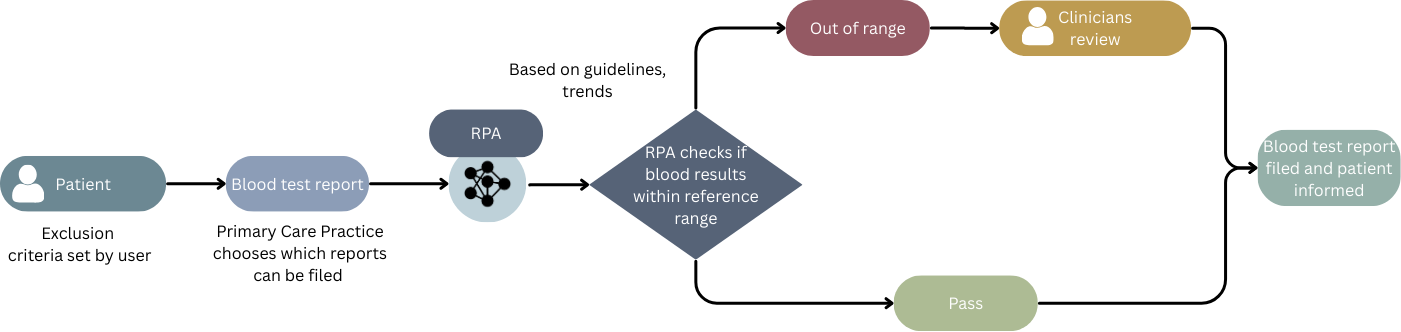
Workflow Diagram
Fabric Score
Task
Patient undergoes blood test. Once blood test report is available, the AI system uses RPA to identify trends/abnormalities. If bloods are classed as ‘normal’ based on guidelines, it will file away the report and can automatically inform patients via SMS.
Intent
The AI system attempts to reduce clinicians having to review ‘normal’ bloods and filing it away, reducing workload.
AI Workflow
Input
Blood test report.
Process
Based on decision trees developed with clinical input, the AI system will class a result as ‘normal’ or ‘abnormal’.
Output
The ‘normal’ lab reports will be filed to patient notes and patient informed of outcome.
Human Oversight Level
Conditionally Autonomous AI
Institutional Oversight Examples
- •Data protection regulation
- •Clinician oversight
- •MHRA - medical device regulation
Risk
A ‘normal’ result may be filed away - but this may not be normal for the patient.
Output Modification Telemetry
- Factual errors / hallucinations90%
- Poor usability (unclear language)10%
Transversal Metrics
Grouped by Fabric dimension.
Efficacy
Accuracy60 %
Efficiency
Modification Rate30 %
Modification Time15 min/output
Verification Time5 min
Rejection Rate10 %
Operational Friction77 hrs/wk
Implementation Overhead200 hrs
Governance Overhead200 hrs
Time to Launch10 wks
Value
Effort Reduction90 %
Risk
Reliability2 incident/month
Autonomy99 %