NHS - Automated Medical Triage
Fabric Score 3.9
PublicHealthNational Health Service UKBoth GenAI and Non-GenAI modelsUser / Operator / Front-line Staff ×1
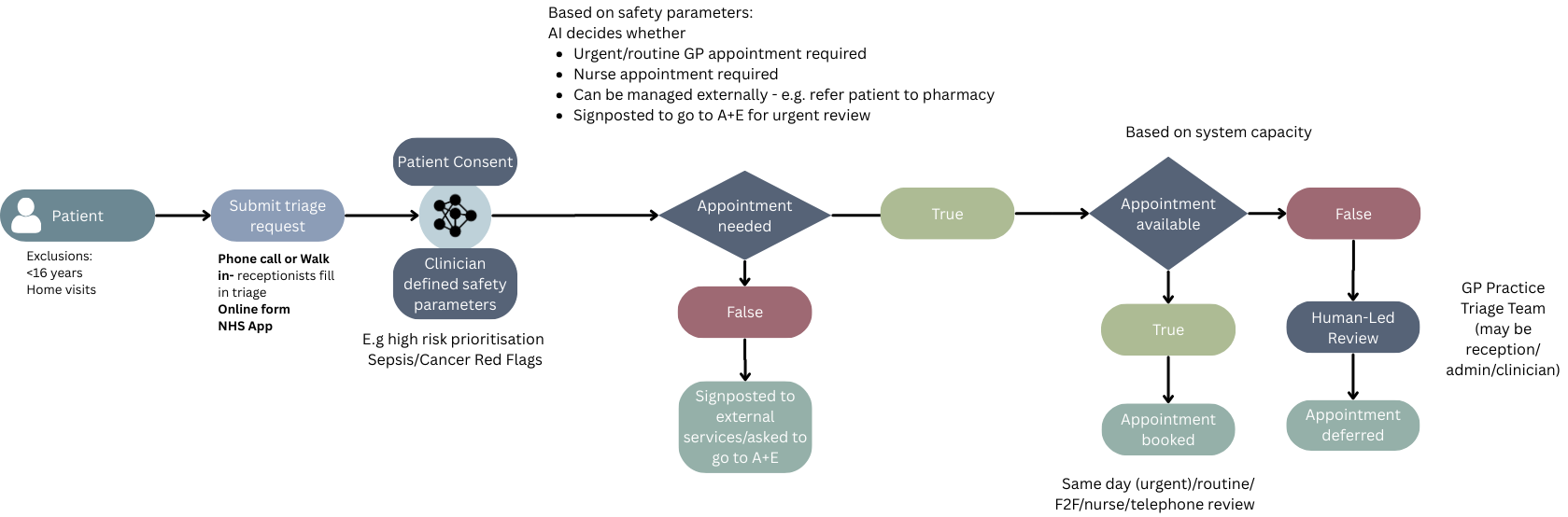
Workflow Diagram
Fabric Score
Task
Patient submits a triage request for a clinical problem. Based on the clinical safety parameters and system capacity, the AI system books an appointment for the patient or re-directs them to external services.
Intent
The AI system aims to control patient flow and reduce burden on admin requests.
AI Workflow
Input
With consent, the patient (or admin team, on behalf of the patient), fills out the online form for triage. This is submitted to the AI system.
Process
Using clinician generated safety parameters, and based on system capacity, the AI system triages the request, and decides whether the patient should be offered an appointment (routine, urgent, F2F, telephone, nurse-led) or signposted to external services (pharmacy/A+E).
Output
The AI system books an appointment for the patient.
Human Oversight Level
Conditionally Autonomous AI
Institutional Oversight Examples
- •Clinical safety parameters
- •Medical device approval (UKCA Class 1 approved)
- •Clinical Risk management (DCB0129 compliant)
Risk
Patients could be wrongly triaged and not seen as urgently as they should be. Forms may be seen by patients as obstruction to care.
Output Modification Telemetry
- Unfaithful outputs (policy, tone, or style misalignment)65%
- Missing or incomplete information10%
- Irrelevant information10%
- Internal inconsistency10%
- Factual errors / hallucinations5%
Transversal Metrics
Grouped by Fabric dimension.
Efficacy
Accuracy90 %
Efficiency
Modification Rate15 %
Modification Time10 min/output
Verification Time5 min
Rejection Rate5 %
Operational Friction5 hrs/wk
Implementation Overhead100 hrs
Governance Overhead100 hrs
Time to Launch4 wks
Value
Effort Reduction90 %
Risk
Reliability5 incident/month
Autonomy85 %