Major Credit Card Company - Transaction Risk Monitoring
Fabric Score 3.9
PrivateFinanceMajor Credit Card CompanyNon-GenAI modelExecutive / Org Leadership ×1
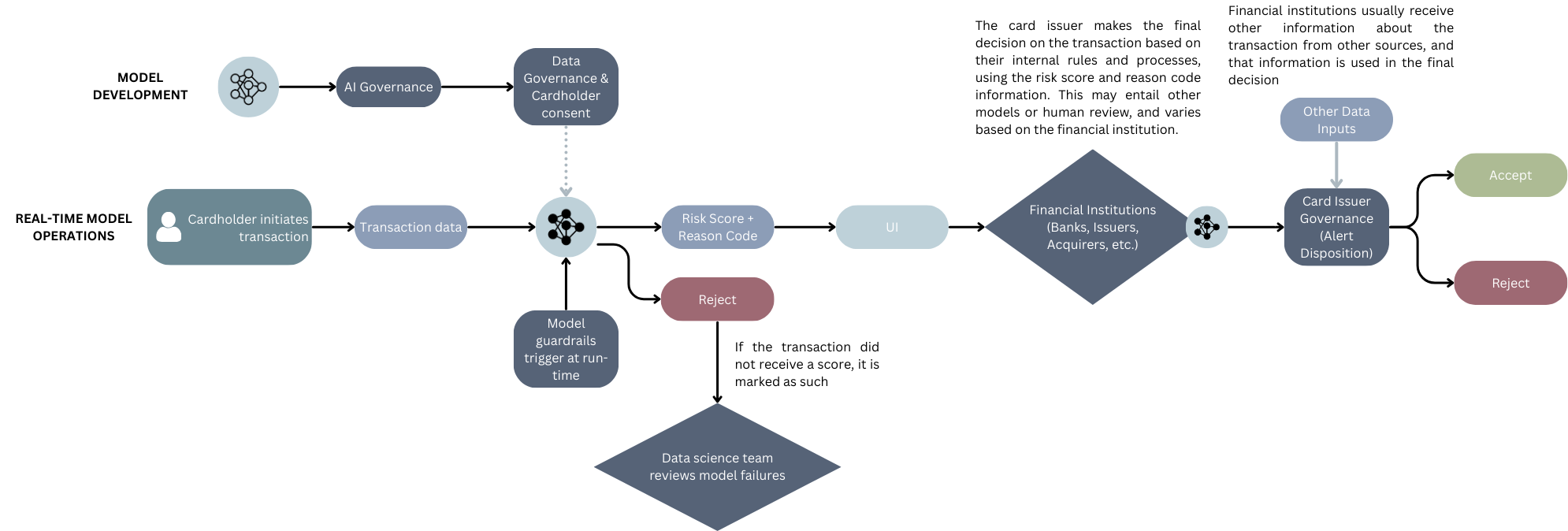
Workflow Diagram
Fabric Score
Task
When a card is used for an in-person transaction, the model generates a risk score for how risky that transaction is. That score is sent to card issuers (banks), and the issuers use the score to make a decision on accepting or rejection the transaction.
Intent
The AI system provides granular risk scores for in-person transaction.
AI Workflow
Input
Card holder uses their credit card at a merchant to make a transaction, a set of data about that transaction is sent to the fraud model.
Process
The AI system generates a risk score for the transaction, which is sent to the financial institutions who make the ultimate decision about whether to accept or reject that transaction.
Output
Output of the fraud model itself is a risk score that is used by the card issuer. The ultimate output is a decision to reject or accept the transaction, which is made by the financial institutions involved.
Human Oversight Level
Conditionally Autonomous AI
Institutional Oversight Examples
- •AI Governance oversees and reviews models
- •Product models are developed and overseen by the data scientists
- •Financial Institutions are governed by a number of regulatory and legal obligations for payments (SR 11-7, FRB, OCC & FDIC regulations in the US)
- •ISO 8583 & ISO 20022
Risk
Transactions could be rejected when they are actually valid, losing customers and trust.
Output Modification Telemetry
- Other100%
Transversal Metrics
Grouped by Fabric dimension.
Efficacy
Accuracy90 %
Efficiency
Operational Friction200 hrs/wk
Implementation Overhead20 hrs
Time to Launch20 wks
Value
Effort Reduction99 %
Effort BurdenN/A (information varies)
Risk
ReliabilityN/A