Lauretta.io - Video Anomaly Detector
Fabric Score 3.5
PublicNational SecurityLauretta.ioBoth GenAI and Non-GenAI modelsDeveloper ×1
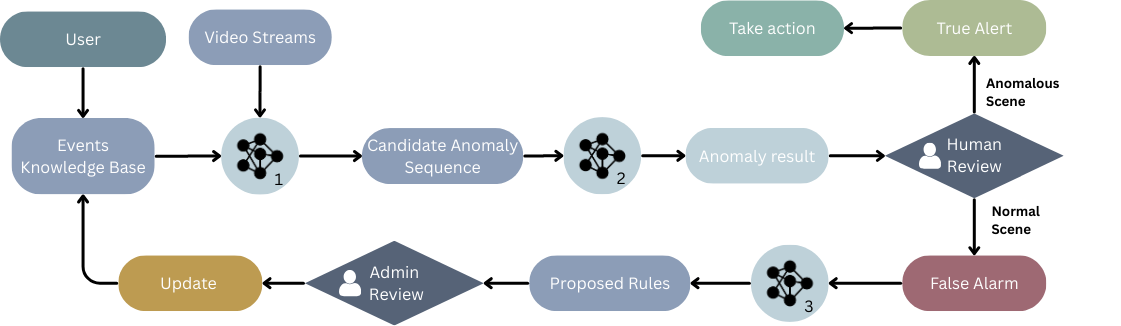
Workflow Diagram
Fabric Score
Task
The AI system continuously analyses video streams and sends alerts to human operators when potential anomalous events are detected.
Intent
The AI system helps to mitigate vigilance decrement by filtering non-critical footage. The AI system acts as a force multiplier, allowing security personnel to focus on validated, high priority threats.
AI Workflow
Input
The AI system ingests video feeds and references an Events Knowledge Base established by the user to describe the normal and anomalous events.
Process
A 2-stage pipeline where Model 1 filters the candidate anomaly sequences and sends them to Model 2 to analyse these sequences to generate an “Anomaly result.” This result will be presented to human operator for validation.
Output
For verified threat, human operator will take action ( e.g., dispatching security). If there’s a false alarm, Model 3 will propose new normal descriptions. The admin will review and decide whether to approve the update to the Event Knowledge Base.
Human Oversight Level
Human-Approved AI
Institutional Oversight Examples
- •Post-deployment monitoring (organization best practice)
- •Regular benchmarking (organization best practice)
- •Periodic audit of user-defined rules (organization best practice)
- •Data retention and deletion schedule (regulation)
Risk
The security guards might become over-reliant on the AI system, leading to complacency where they fail to notice events that the AI system misses. The detection accuracy may degrade if the knowledge base is corrupted by erroneous manual updates during the feedback loop.
Output Modification Telemetry
- Factual errors / hallucinations100%
Transversal Metrics
Grouped by Fabric dimension.
Efficacy
Accuracy80 %
Efficiency
Modification Rate10 %
Modification Time3 min/output
Verification Time3 min
Rejection Rate20 %
Operational Friction5 hrs/wk
Implementation Overhead160 hrs
Governance Overhead40 hrs
Time to Launch7 wks
Value
Effort Reduction60 %
Risk
Reliability0.5 incident/month
Autonomy80 %