KyklosTech - Guideline-Integrated Decision Engine for Health

Fabric Score 4.6
PublicHealthKyklosTechBoth GenAI and Non-GenAI modelsProduct Owner ×1

Workflow Diagram

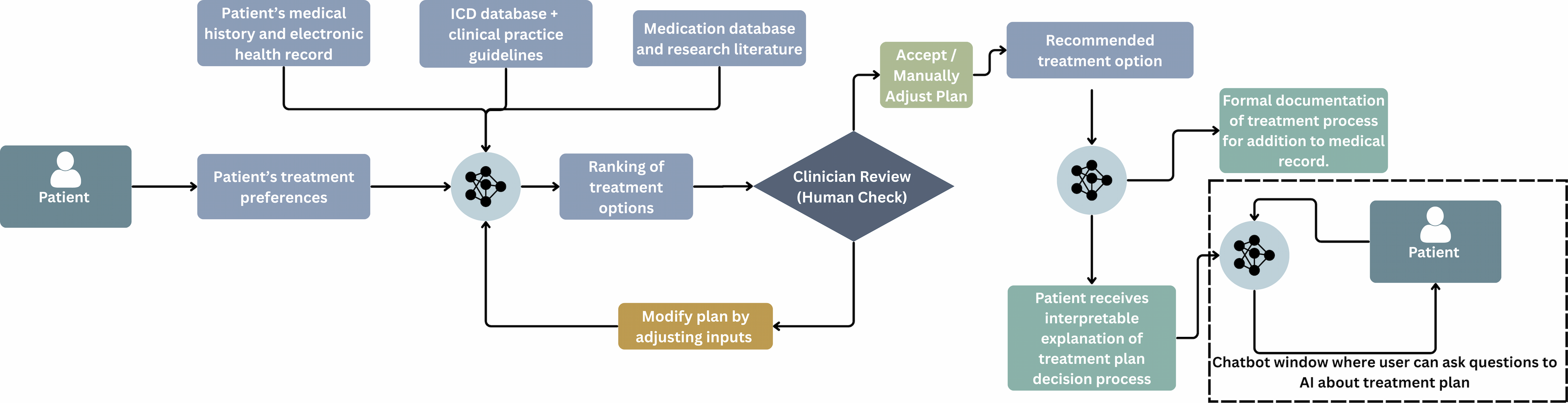
KyklosTech - Guideline-Integrated Decision Engine for Health workflow diagram

Fabric Score

ValueEfficacySecurityRiskExternalitiesEfficiency3.25.05.04.84.65.04.6Fabric Score

Task

Assist clinicians by generating supportive treatment recommendations, explanations to patient, and documentation for a patient’s electronic health record (EHR). It also optimises treatment in cases of multimorbidity: if a patient has multiple diagnoses, finding the best concoction of medications to treat all diagnoses while preventing negative synergistic effects becomes a complex problem.

Intent

Improve clarity, personalisation, and comprehensiveness of documentation to improve patient adherence to medical plans; create better treatment plans for multimorbidity by checking all permutations of combined drug treatments.

AI Workflow

Input

The patient’s electronic health record (EHR); the International Classification of Diseases (ICD) database and clinical practice guidelines (CPG), which documents proper treatment of particular illnesses; the patient’s preferences; and a database of possible medications to treat various illnesses, as supported by the medical literature.

Process

An LLM automatically extracts and contextualises patient information in the EHR to identify the disease state and ranks possible interventions based on information from the medical literature and the individual patient. The clinician picks the proper intervention.

Output

The model generates two versions of the treatment plan: the first is in formal medical language for inclusion into the patient’s EHR, and the second is a patient-friendly explanation of the treatment and how this treatment plan was chosen. Once the patient receives the treatment plan, they can chat with the same LLM that created the treatment plan to ask questions about their treatment.

Human Oversight Level

Human-Approved AI

Institutional Oversight Examples

  • Digital Clinical Safety Practice
  • Data Protection Regulation
  • Equality and health impact assessment
  • Documentation defensibility and auditability

Risk

AI recommendations could be misconstrued as authoritative; human validation remains essential.

Output Modification Telemetry

  • Factual errors / hallucinations38%
  • Missing or incomplete information35%
  • Unfaithful outputs (policy, tone, or style misalignment)22%
  • Poor usability (unclear language)5%

Transversal Metrics

Grouped by Fabric dimension.

Efficacy

Accuracy97 %

Efficiency

Modification Rate10 %
Modification Time1 min/output
Verification Time1 min
Rejection Rate1 %
Operational Friction1 hrs/wk
Implementation Overhead2 hrs
Governance Overhead30 hrs
Time to Launch2 wks

Value

Effort Reduction95 %

Risk

Reliability0 incident/month
Autonomy95 %