Civic AI - Congressional Correspondence
Fabric Score 3.9
PublicPublic ServicesCivicGenAI modelExecutive / Org Leadership ×1
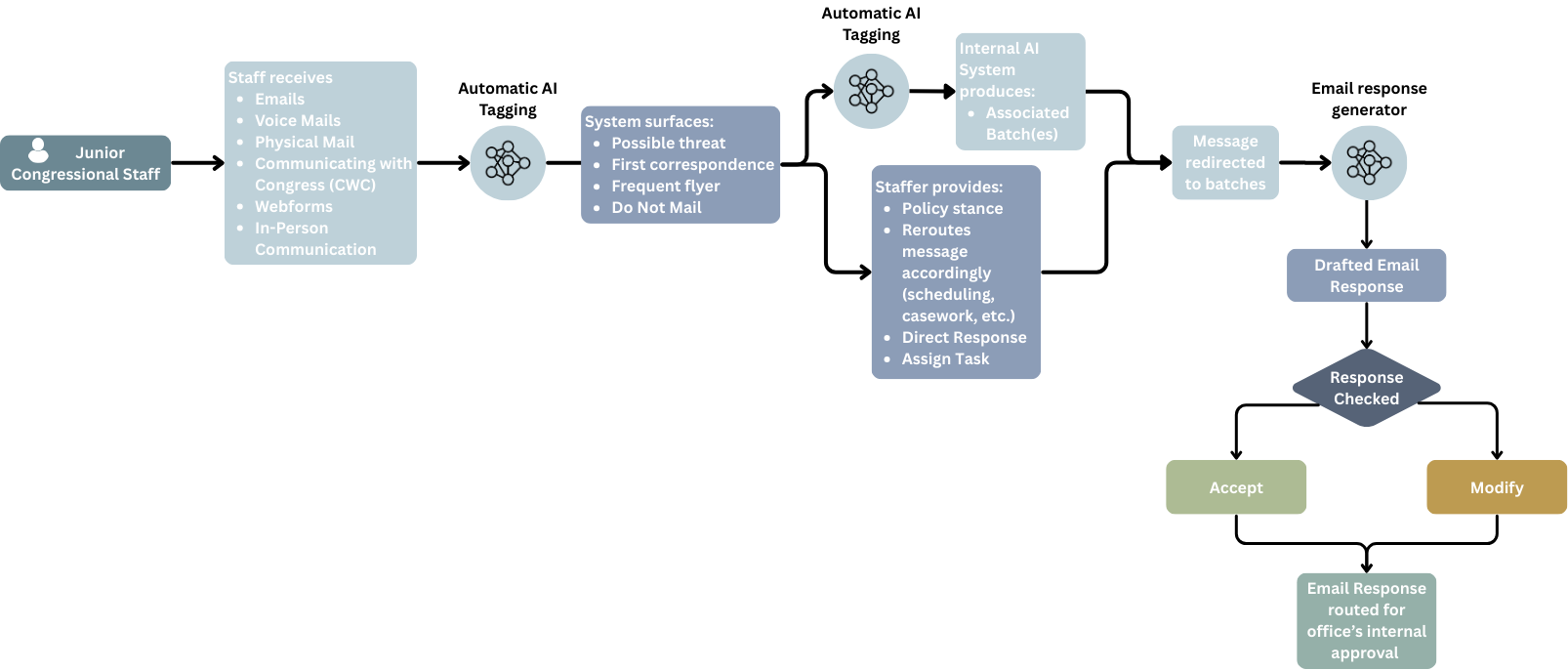
Workflow Diagram
Fabric Score
Task
Automate the triage, batching, and first-draft response of constituent correspondence.
Intent
Legislative offices receive hundreds to thousands of messages weekly, overwhelming staff and delaying responses. This AI system rapidly organises and triages incoming correspondence by topic and sentiment, enabling timely, consistent, and scalable responses while preserving constituent data.
AI Workflow
Input
AI TaggingPhone, mail, email, or in-person communication.
Response DraftingMessages within an active batch.
Process
AI TaggingMessage content is analysed for an explicit reference to a bill number or bill title. If no bill is identified, the AI system searches for a broader policy topic. Each message is also assigned a sentiment (i.e., pro/con/neutral).
Response DraftingMessage content, sentiment, and metadata are aggregated and analysed alongside the legislator’s public statements. The legislator’s existing data room is used to ensure response is aligned and consistent with prior positions.
Output
AI TaggingMessages are grouped in batches by sharing the same topic and constituent sentiment.
Response DraftingA response written in the legislator’s voice is generated, accepted or modified, and advanced through approval workflow.
Human Oversight Level
Human-Led with AI Assistance
Institutional Oversight Examples
- •Models must be fully closed, secured, and incapable of leaking data
Risk
Potential hallucinations, faulty batches, and factually incorrect responses.
Output Modification Telemetry
- Factual errors / hallucinations50%
- Unfaithful outputs (policy, tone, or style misalignment)30%
- Other10%
- Missing or incomplete information5%
- Irrelevant information5%
Transversal Metrics
Grouped by Fabric dimension.
Efficacy
Accuracy80 %
Efficiency
Modification Rate20 %
Modification Time12.5 min/output
Verification Time7.5 min
Rejection Rate5 %
Operational Friction0 hrs/wk
Implementation Overhead400 hrs
Governance Overhead150 hrs
Time to Launch24 wks
Value
Effort Reduction90 %
Risk
Reliability5 incident/month
Autonomy95 %