Civic AI - Casework Triage
Fabric Score 4.1
Civil SocietyPublic ServicesCivicNon-GenAI modelDeveloper ×1
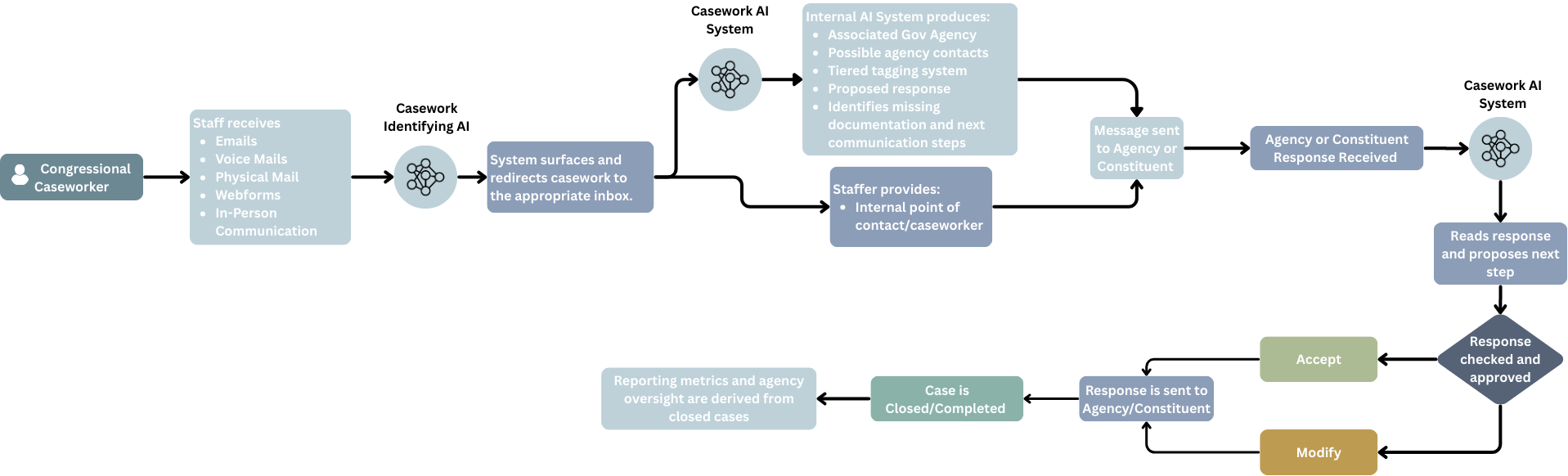
Workflow Diagram
Fabric Score
Task
Assist with intake, triage, categorisation, prioritisation, documentation, and draft support for constituent casework requests.
Intent
Legislators and staff receive a high volume of complex, time-sensitive casework requests across agencies and issue areas. The AI system supports staff by structuring intake, identifying urgency and agency ownership, maintaining a complete case history, and assisting with drafting agency correspondence while preserving constituent privacy and data integrity.
AI Workflow
Input
Casework Identifying AIIncoming casework requests submitted via phone call, web form, email, mail, or in-person interactions.
AI Casework SystemA message from a constituent or an agency regarding a new or ongoing piece of casework.
Process
Casework Identifying AIThe request content is analysed to determine whether it is casework or policy-related.
AI Casework SystemThe message content is analysed to identify the issue area, relevant government agency, urgency level, and required documentation. Personally identifiable information is structured into standardised case fields. Similar cases may be routed to the same internal staff for oversight.
Output
Casework Identifying AIThe message and its content are kept in the policy inbox or rerouted to the casework inbox.
AI Casework SystemDraft communications and status updates prepared for staff review, modification, and approval, with all actions logged within the case history.
Human Oversight Level
Human-Led with AI Assistance
Institutional Oversight Examples
- •Models must be fully closed, secured, and incapable of leaking data
- •Casework data is owned by the office
- •Use is governed by internal office policies, constituent privacy expectations, and applicable federal and state data protection requirements
Risk
Mishandled sensitive information, incorrect agency routing, delay in services provided, or inaccurate case status updates.
Output Modification Telemetry
- Factual errors / hallucinations25%
- Unfaithful outputs (policy, tone, or style misalignment)20%
- Irrelevant information20%
- Missing or incomplete information15%
- Other15%
- Poor usability (unclear language)3%
- Internal inconsistency2%
Transversal Metrics
Grouped by Fabric dimension.
Efficacy
Accuracy98 %
Efficiency
Modification Rate5 %
Modification Time3 min/output
Verification Time3 min
Rejection Rate2 %
Operational Friction7 hrs/wk
Implementation Overhead1000 hrs
Governance Overhead600 hrs
Time to Launch52 wks
Value
Effort Reduction40 %
Risk
Reliability2 incident/month
Autonomy40 %